Virtual try-on apps are changing how we shop for fashion products. They use augmented reality to let users see how items look on them before buying. This technology is making online shopping more interactive and personal.
These apps are especially popular in the fashion and beauty industries. They help users experiment with different styles and colors without any commitment. From trying on clothes to testing nail polish shades, the possibilities are endless.
Virtual try-on apps are not just convenient; they also reduce the need for physical samples. This makes them an eco-friendly option. As technology advances, these apps are becoming more realistic and accessible to everyone.
What Is a Virtual Try On App?
A virtual try-on app allows users to visualize products on themselves through digital simulations. By using augmented reality, these apps create realistic experiences for users within their own space. They make shopping not only convenient but also highly personalized.
These applications have become vital in the fashion and beauty sectors. They grant shoppers the ability to try items from the comfort of their homes. It’s like having a digital fitting room available anywhere you go.
Some common features of virtual try-on apps include:
- Augmented reality overlays
- Real-time visualization
- Customizable options
Imagine trying on sunglasses or checking earrings size without any physical product.
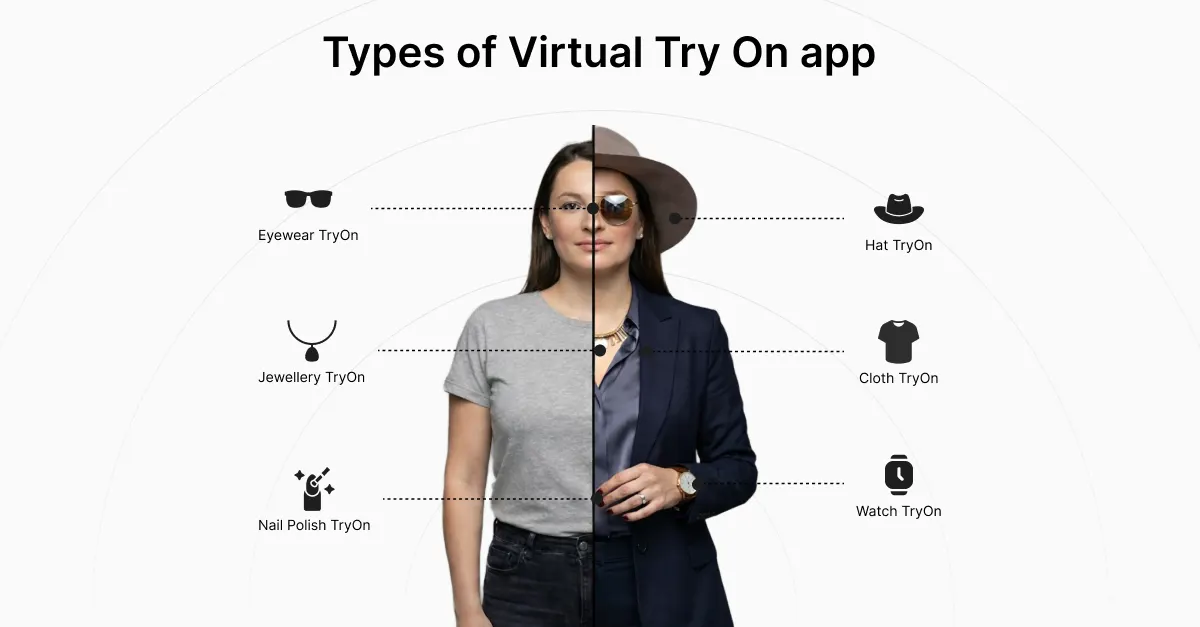
1. Jewelry Virtual Try-On
Jewelry virtual try-on enables customers to see rings, earrings, necklaces, bracelets, and pendants on their own image or live camera feed.
-
Common formats: Rings, earrings, necklaces, bangles
-
Technology used: AI face/hand detection, 2D overlays, and 3D rendering
-
Benefits: Accurate sizing perception, improved engagement, higher conversion
-
Assets required: Product images in front view in PNG/JPG/WEBP or 3D files in GLB format and length for earrings and pendants.
Advanced jewelry try-on platforms support 3D jewelry visualization, allowing realistic reflections, depth, and movement—especially important for fine jewelry and bespoke designs.
2. Eyewear Virtual Try-On
Eyewear virtual try-on lets users try glasses or sunglasses virtually using face landmarks.
-
Common formats: Optical frames, sunglasses
-
Technology used: Face mesh tracking, 3D frame fitting
-
Benefits: Helps customers choose the right fit, reduces return rates
-
Assets required: Product images in front and side view in PNG/JPG/WEBP or 3D files in GLB format.
Eyewear VTO often uses 3D models mapped onto facial geometry, ensuring accurate alignment even with head movement.
3. Watch Virtual Try-On
Watch virtual try-on allows customers to preview watches on their wrist in real time.
-
Common formats: Luxury watches, smartwatches, fashion watches
-
Technology used: Hand tracking, wrist detection, 3D watch models
-
Benefits: Realistic scale, better style matching
-
Assets required: Product images in front view in PNG/JPG/WEBP or 3D files in GLB format.
4. Clothing Virtual Try-On
Clothing virtual try-on is one of the most advanced and impactful applications of VTO.
-
Common formats: Tops, dresses, jackets, ethnic wear
-
Technology used: Body detection, pose estimation, AI garment draping
-
Benefits: Size confidence, fewer returns, better shopping experience
-
Assets required: Product images in front view in PNG/JPG/WEBP or 3D files in GLB format.
Clothing try-on can be 2D (image-based overlays) or 3D (full-body avatars with physics-based cloth simulation) depending on accuracy and performance needs.
5. Hat & Headwear Virtual Try-On
Hat virtual try-on allows users to see caps, hats, helmets, or head accessories on their head.
-
Technology used: Head tracking, face landmarks
-
Benefits: Ensures correct scale and positioning
-
Assets required: Product images in front view in PNG/JPG/WEBP or 3D files in GLB format.
Both 2D and lightweight 3D models are commonly used for headwear try-on.
6. Nail Polish Virtual Try-On
Nail polish virtual try-on lets users visualize different shades on their own hands.
-
Technology used: Hand segmentation, nail detection
-
Benefits: Shade accuracy, faster purchase decisions
-
Assets required: Product images in front view in PNG/JPG/WEBP
Top Features to Look for in a Virtual Try On App
When choosing a virtual try-on app, focus on features that enhance user experience. The right features can make an app more effective and enjoyable.
Firstly, accuracy in augmented reality (AR) is crucial. A precise AR feature ensures that visualizations are realistic. This leads to better decision-making for users.
User interface simplicity is another important aspect. Easy navigation ensures that users spend more time exploring rather than figuring out how the app works.
Consider these top features:
- High-accuracy augmented reality
- Intuitive and clean design
- Wide selection of products and styles
- Easy integration with platforms like Shopify
- Real-time try-on capabilities
Best Virtual Try On Apps for Fashion
The demand for virtual try-on apps is booming, with many options available for fashion and beauty enthusiasts. These apps use advanced technology to offer a realistic preview of how products will look on you.
Popular apps include options for clothing, hair, makeup, and accessories. They cater to all retail needs by providing tailored experiences.
Some top apps to explore include:
- ModiFace: Known for its realistic virtual hair color try-ons.
- Warby Parker: Renowned for its virtual try-on glasses app, offering seamless eyewear fitting.
- Camweara: stands out for its accuracy, lightweight, affordability and highest rated virtual try on app on Shopify.
How to Choose the Right Virtual Try On App
Selecting the perfect virtual try-on app can enhance your shopping experience. Consider your specific needs and the product types you want to try. Compatibility with your device and user-friendliness are also crucial factors.
To help with your decision, look for:
- Product Range: The variety of items the app supports.
- Ease of Use: How intuitive and easy it is to navigate.
- Accuracy: Realistic representation in virtual try-ons.
Finding an app that aligns with these aspects ensures a seamless and enjoyable user experience. Ensure the app meets your expectations for trying on fashion or beauty products efficiently.
The Future of Virtual Try On Technology
Virtual try-on technology is set to evolve rapidly. With advancements in artificial intelligence and augmented reality, future applications will become even more immersive. New features like 3D body scanning promise heightened accuracy and customization.
Integration with virtual reality will transform how users engage with fashion and beauty products. As technology becomes more accessible and affordable, wider adoption across industries is anticipated. This evolution will further close the gap between digital and physical shopping experiences.